Offshore Corrosion Inspection Software: From Clipboards to Confidence
Offshore corrosion inspection software is quietly transforming how oil and gas operators manage asset integrity – replacing fragmented, spreadsheet-driven workflows with structured maintenance planning.
As offshore assets age and regulatory scrutiny increases, inspection teams are expected to deliver more – stronger traceability, consistent reporting, and clear, defensible records that stand up to review. Yet many corrosion inspection workflows still rely on paper notes, manual photo storage, and multiple disconnected trackers.
- The Cost of Corrosion
- Why Manual Inspection Workflows Break Down Offshore
- Best Practice in Offshore Corrosion Inspection Software
- Lessons from the Field: Shell’s Use of Degradation Forecasting
- Evidence That Digital Inspection Improves Outcomes
- Choosing the Right Offshore Corrosion Inspection Software
- The Future of Offshore Corrosion Inspection Software
The Cost of Corrosion – And the Cost of Poor Data
The economic impact of corrosion is well established.
The NACE International (now AMPP) IMPACT study estimated the global cost of corrosion at approximately US $2.5 trillion per year, equivalent to around 3.4% of global GDP (2013 basis). The study also concluded that a significant portion of these costs could be avoided through improved corrosion management practices.
In offshore oil and gas, corrosion is not just a financial issue – it’s a safety and regulatory issue. The UK Health and Safety Executive (HSE) makes clear that dutyholders must demonstrate robust structural integrity management arrangements. Inspection data must therefore be:
- Traceable
- Reviewable
- Version-controlled
- Audit-ready
Manual workflows make that difficult. Offshore corrosion inspection software makes it systematic.
Why Manual Inspection Workflows Break Down Offshore
Traditional corrosion inspection processes typically involve:
- Field capture on paper
- Separate photo storage
- Manual transcription into spreadsheets
- Email-based QA
- Multiple tracker updates
- Separate action management systems
Each handover increases risk:
- Transcription errors
- Lost context
- Duplicate surveys
- Delayed reporting
- Inconsistent approvals
As Surface operations director Steve Brierley observed in his article “Still Drowning in Data? You’re Not Alone,” many integrity teams are collecting more data than ever – but struggling to turn it into action. The issue isn’t data volume. It’s fragmentation. Effective offshore corrosion inspection software solves fragmentation first.
Best Practice in Offshore Corrosion Inspection Software
To genuinely improve offshore inspection management, software must address four core areas:
1. Simple, Structured Field Capture
Digital corrosion inspection software should
- Work offline
- Allow structured defect categorisation
- Automatically timestamp entries
- Attach photos directly to records
- Reduce free-text variability
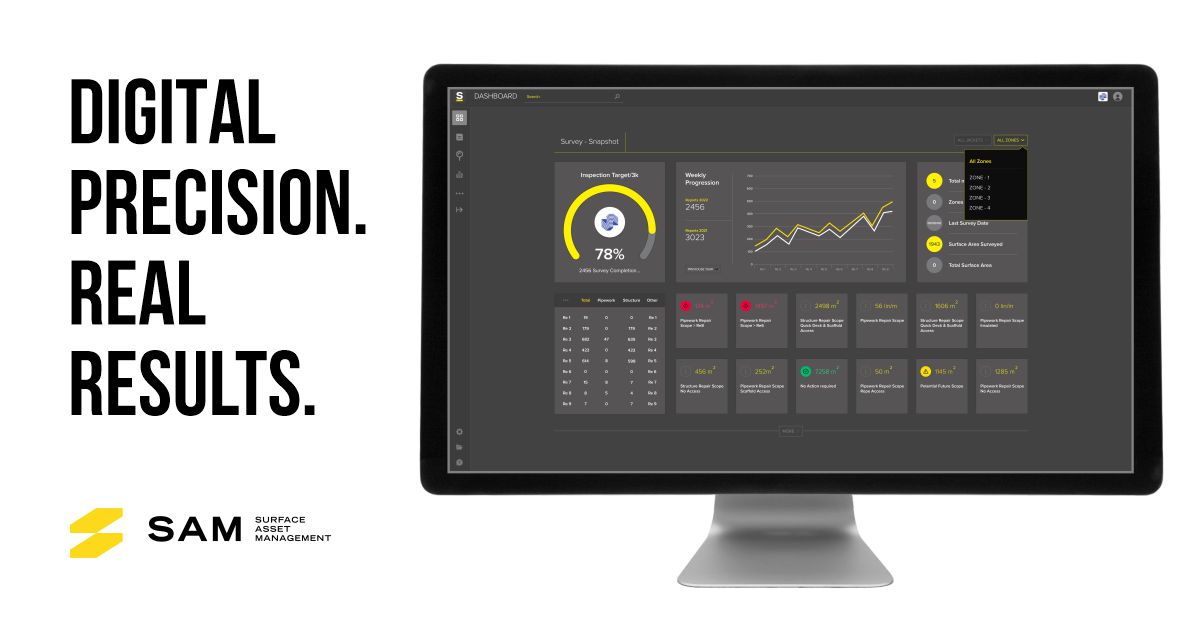
The SAM™ platform eliminates spreadsheets, disconnected tools and manual reporting by creating a single structured view of inspection data.
Simplicity matters. If capture is complicated, inspectors work around it.
2. Alignment With Industry Standards
Offshore inspection management software must support structured data that aligns with recognised standards. Relevant frameworks include:
ISO (international)
- ISO 12944 – Protective paint systems for steel structures (very widely used)
- ISO 8501-1 – Rust grades and surface preparation (Sa 2½, St 3, etc)
- ISO 8502 – Surface cleanliness tests (salts, dust, etc)
- ISO 8503 – Surface roughness profiles
- ISO 19840 – Dry film thickness (DFT) measurement and acceptance
- ISO 4628-3 Inc Annex - European Re and Ri Corrosion Scales
NORSOK (offshore oil & gas)
- NORSOK M-501 – Surface preparation and protective coating (the offshore gold standard)
- NACE / AMPP (corrosion-focused)
- NACE SP0178 – Holiday testing of coatings
- NACE SP0188 – DFT measurement
- ASTM D610 - Standard Practice for Evaluating Degree of Rusting on Painted Steel Surfaces
These standards reinforce consistent defect classification, inspection methodology and reporting integrity – all of which benefit from a digitally controlled workflow.
3. Embedded Quality Assurance and Audit Control
Offshore corrosion inspection software must go beyond digital forms and embed governance into the workflow. That includes:
- Role-based approvals
- Digital sign-offs
- Revision history tracking
- Automated validation checks
- Secure archiving of historical records
Offshore operators must be able to demonstrate not just what was inspected – but who reviewed it, when it was approved, and under which criteria.
In regulated environments, inspection software must support audit readiness by design – not as an afterthought.
4. Integrated Action Management and Degradation Forecasting
Inspection only adds value when findings lead directly to the right work being carried out. Modern offshore corrosion inspection software captures accurate data in real time, controlling it through a structured workflow and turn inspection results into clear, work-ready scopes:
- Convert findings directly into corrective actions
- Assign ownership and deadlines
- Track progress in real time
- Capture close-out evidence
- Feed completed actions back into historical records
Beyond that, mature systems should support:
- Trend analysis across inspection cycles
- Risk-based prioritisation
- Budget scenario modelling
- Predictive degradation forecasting
This is where inspection becomes more than a report. When the whole process is handled in one system, it makes it easier to plan and deliver the right work.

Lessons from the Field: Shell’s Use of Degradation Forecasting
Shell’s joint venture NAM engaged Surface to deploy SAM™ and develop a bespoke DFM capability to support long-term, portfolio-level planning across its offshore assets.
Instead of asking: “What did we find this year?” Asset managers can ask more strategic questions:
- What happens if intervention is deferred by 12 months?
- How does adjusting maintenance spend affect future degradation rates?
- Where is corrosion risk likely to accumulate across the portfolio?
By running different timing and budget scenarios, teams can see how today’s decisions influence tomorrow’s risk profile.
Some of Shell’s use of DFM is iterative – testing various intervention strategies to identify a workable balance between asset integrity and expenditure. In simple terms, they are using data to find the “sweet spot” between over-maintaining and under-protecting.
This is the shift from reactive maintenance to informed planning.
When offshore corrosion inspection software connects structured capture, action management and degradation forecasting into one workflow, inspection data becomes more than a record of defects. It becomes a decision-support tool. And that is where real asset integrity value is created.
Evidence That Digital Inspection Improves Outcomes
The benefits of digital offshore corrosion inspection aren’t theoretical. Industry research consistently shows that improved corrosion management practices reduce avoidable cost and risk. The NACE (AMPP) IMPACT study highlights that better corrosion management can materially reduce global corrosion expenditure.
Trade reporting also points to the growing reliability and usability advantages of structured digital monitoring and inspection systems compared with fragmented manual workflows. As monitoring technologies advance, the real differentiator is not simply collecting more data – but managing it in a structured, traceable and actionable way. Digitisation improves:
- Reporting cycle times
- Data consistency
- QA transparency
- Traceability of decisions
- Audit readiness
- Maintenance prioritisation
This shift is increasingly recognised by contractors and asset operators. Sandy Bonner, President Engineering & Maintenance UK at Bilfinger, commented on adopting SAM™:
“Digitalisation is a key enabler for our business, and adopting SAM is another step in our commitment to innovation and efficiency. This user-friendly platform allows our integrity teams to survey, estimate and successfully manage multiple work scopes consistently and transparently across our global assets delivering long-term value for our clients.”
The message from across the sector is clear: better structured inspection data leads to better decisions – and stronger long-term asset integrity performance.
Choosing the Right Offshore Corrosion Inspection Software
Not all digital inspection tools are built for offshore oil and gas environments. Effective offshore corrosion inspection software should:
- Operate fully offline
- Provide structured execution and QA workflows
- Offer revision control and approval logs
- Integrate action management
- Enable degradation forecasting
- Support multi-asset portfolio reporting
Systems that prioritise simplicity tend to perform better offshore than complex, feature-heavy alternatives. Because in offshore environments, simplicity equals reliability.
By Inspectors, For Inspectors
One of the differentiators of our approach is its origin. We’re a corrosion consultancy whose inspectors shaped the SAM ™ platform. This matters.
Offshore corrosion inspection software designed by field practitioners reflects real-world constraints like weather limitations, contractor interfaces and QA bottlenecks.
The SAM™ workflow mirrors practical inspection cycles. That alignment increases adoption – and adoption drives data quality.
The Future of Offshore Corrosion Inspection Software
Offshore corrosion inspection software is no longer a nice-to-have. It is becoming a core part of asset integrity management.
The organisations getting it right are not the ones collecting the most data, but the ones managing it properly and turning inspection findings into clear work.
When capture, QA, action tracking and forecasting are connected, inspection stops being an administrative task and becomes a strategic management tool. That is the shift from compliance to confidence.
Reviewing your offshore corrosion inspection workflow? Speak with our team to explore how structured digital inspection can support stronger asset integrity planning.
Get In Touch arrow_forward